

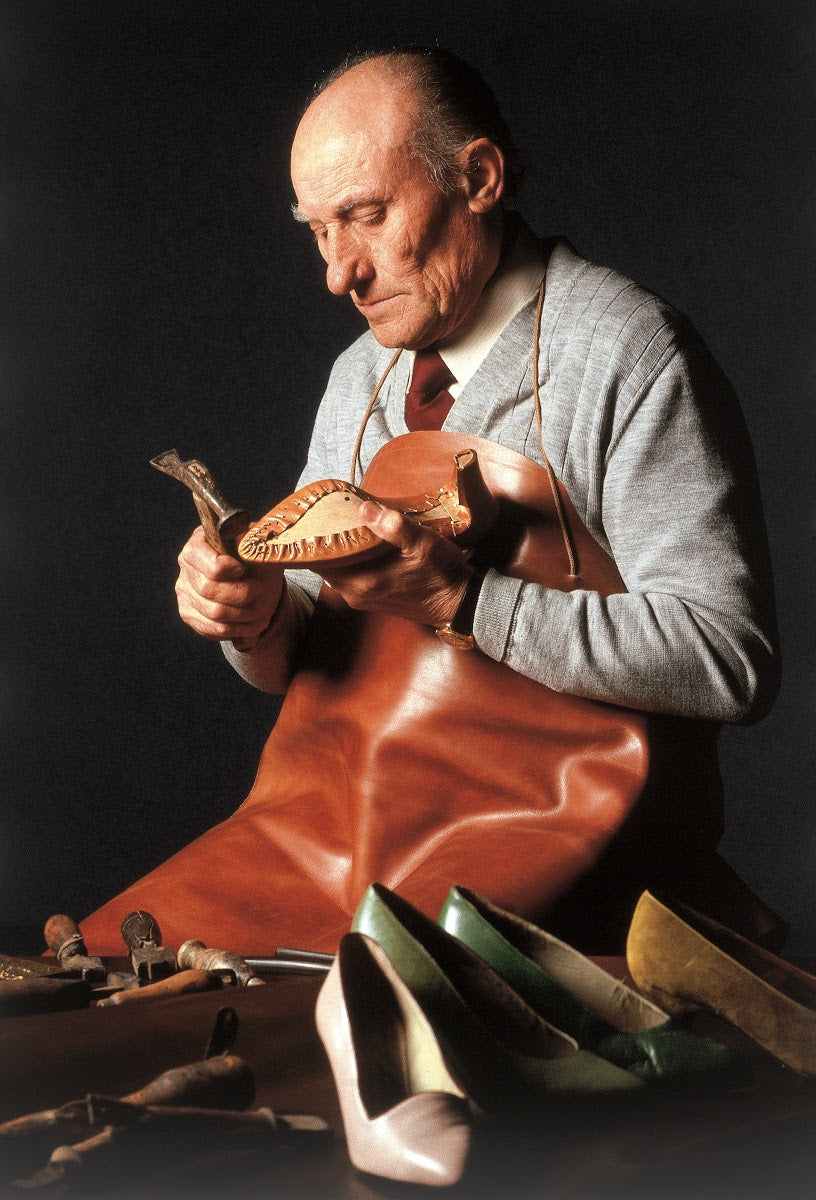
1942 — Riviera del Brenta, Venice
Along the Naviglio del Brenta, between the mainland and the Venetian lagoon, time moves differently.
Narciso Rossi opens a small workshop.
Only a few pairs a day, entirely made by hand.
The work is slow, precise, repeated.
Each gesture is refined over time, until it becomes instinctive.
His sons grow up beside him. They observe, learn, repeat.
There is no formal education, only the continuity of making.
In this part of Veneto, shoemaking is a shared tradition.
The Rossi workshop belongs to it, without seeking distinction, only continuity.
Rossimoda
In 1947, the work becomes structured and takes the name Rossimoda.
With the brothers Luigino, Diego, and Dino, the activity grows and organizes itself.
Scale changes, but the method remains unchanged.
Each shoe is still built with precision, without excess.
Paris
In the early 1960s, a moment of change.
In Paris, on the Champs-Élysées, Luigino Rossi stops in front of the boutique of Charles Jourdan.
In the window, the shoes are arranged with a quiet precision that draws his attention. He studies them, proportions, construction, the restraint of detail.
He enters the boutique of Charles Jourdan.
Not as a client, but as someone who recognizes a familiar language.
Charles Jourdan observes him before anything is said. The way he handles the shoes is enough. Recognition is immediate, of craft, of origin, of understanding.
A conversation begins quietly, beyond commerce. It is about making, about discipline, about how form is constructed and refined.
Jourdan later invites the Rossi family to his factory in Romans. An opening between two worlds, connected by the same rigor expressed in different ways.
From that encounter, a new direction begins to take shape.
The Licenses
Over the following decades, collaborations on license define a large part of the work of Rossimoda.
Shoes are created for some of the most important maisons of the time, including Yves Saint Laurent, Christian Dior, Givenchy, Fendi, Valentino, Céline, Kenzo, Calvin Klein, and Marc Jacobs.
They carry different names, yet they are always made in the same place: the Riviera del Brenta.
For decades, the work remains steady.
Precise, continuous, largely unseen.
Memory
In 1995, part of this journey is preserved in Villa Foscarini Rossi.
A seventeenth-century villa on the Brenta becomes a museum, holding more than a thousand shoes created over decades of collaboration with the great maisons.
Each pair is an object, but also a trace of a process. Together they form an archive of making rather than display.
The villa does not narrate history as celebration. It preserves it as evidence.
LVMH
In 2003, Rossimoda joins the LVMH group.
The factory and the villa enter the world's largest luxury house.
The making continues where it has always been, on the Brenta, with the same hands and the same discipline.
What changes is the structure. What remains is the method.
Today
Now in its fourth generation, the starting point has shifted.
After a long history of producing for others, a more essential direction emerges.
It is no longer about adding, but about choosing.
Reducing until only what matters remains.
Forms become purer.
Proportions more controlled.
Each element has a clear role.
What remains is not a reduction of history, but its connection.